Designing an AI agent
for the travel industry
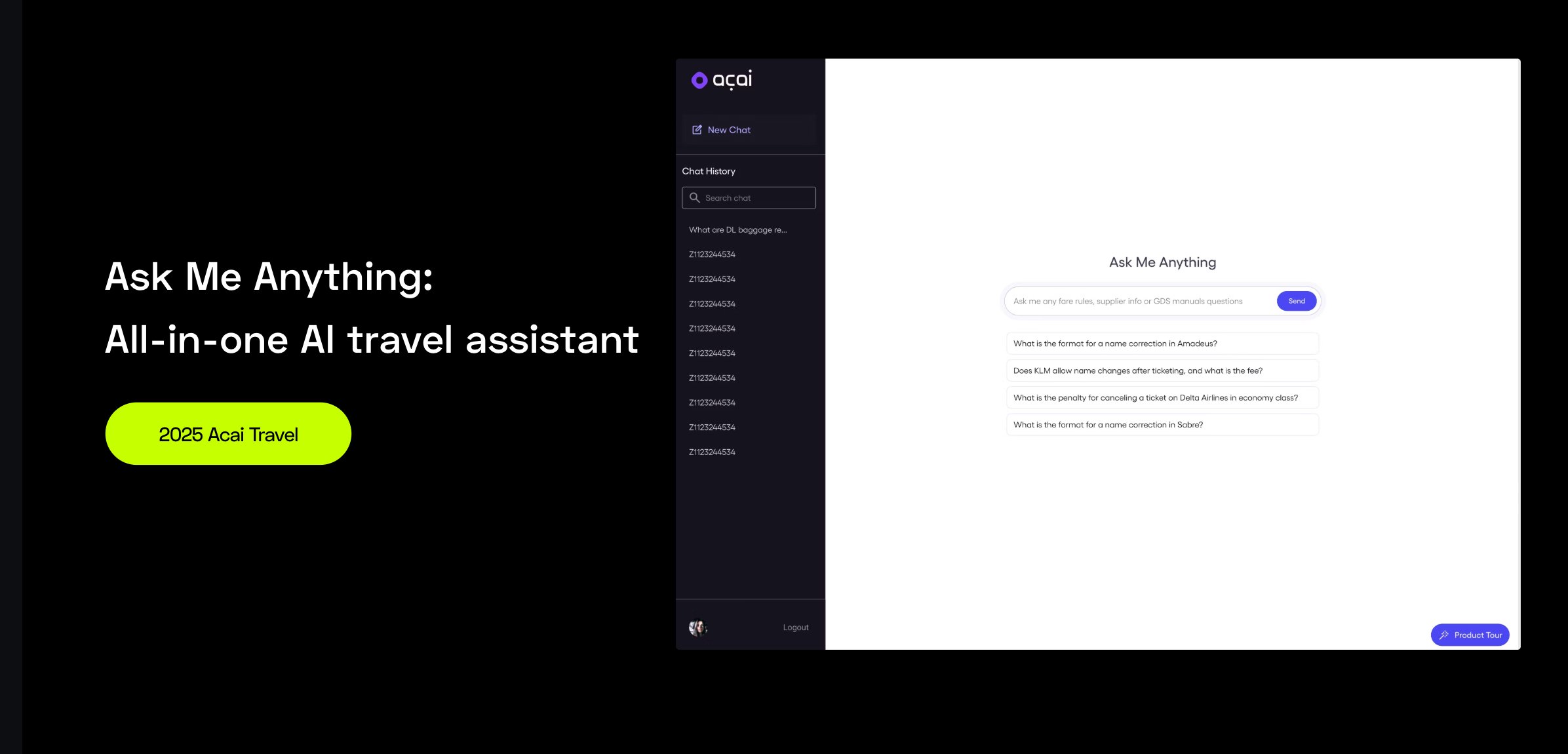
AMA is an agentic AI assistant built for Acai Travel — enabling travel agents to query fare rules, supplier info, and GDS manuals in seconds, replacing hours of manual lookup.
The hidden cost of
manual knowledge work
Travel agents at Acai spend a significant part of their day answering repetitive, high-stakes questions — What are the baggage rules on this fare? Can this ticket be name-corrected in Amadeus? What's the penalty for cancelling this Delta economy ticket?
The answers exist — scattered across airline fare manuals, GDS documentation, supplier PDFs, and internal wikis. But finding them takes 5 to 30 minutes per query, pulling agents out of flow and creating bottlenecks during peak booking periods.
"How might we give travel agents instant, reliable answers to complex fare and supplier questions — without replacing their expertise?"
A day in the life of
a travel agent
We ran contextual inquiry sessions, shadowing agents through their daily workflows. We also analysed support ticket logs and conducted structured interviews to understand the most common and costly knowledge gaps.
Time lost
Agents spent up to 40% of their day searching for answers across disconnected systems — manuals, Slack, email threads, GDS help docs.
High stakes errors
Misreading a fare rule or missing a name-correction window could mean hundreds of euros in airline penalties — agents were stressed and second-guessing themselves.
Repeated questions
80% of questions were variations of the same 20 scenarios. Senior agents were constantly interrupted to answer questions junior agents couldn't find answers to.
A key insight emerged: agents didn't want to be replaced by AI — they wanted a knowledgeable colleague on demand. Someone who knew the rules cold and could give a confident, citable answer instantly.
Designing for
trust in AI answers
The core design challenge wasn't the chat interface — it was making agents trust the answers enough to act on them. An AI that gives wrong fare advice can cause real financial harm. Confidence calibration and source transparency were central design problems.
Discovery
Shadowing sessions, ticket log analysis, 12 agent interviews. Mapped the full knowledge-work journey.
Framing
Defined the AI's "personality" — confident but citable. Scoped MVP queries: fare rules, name corrections, cancellation penalties.
Design
Iterated on conversation UI, source citation patterns, suggested questions, and history architecture.
Validate
Weekly usability tests with real agents on real queries. Measured answer trust, time-to-action, and error rates.
One of the most important design decisions was adding source citations to every answer — showing exactly which fare manual or GDS doc the answer came from. This single change dramatically increased agent confidence and willingness to act on AI responses without double-checking.
From hours of search
to seconds of certainty
AMA is a conversational AI interface embedded in the Acai Travel platform. Agents type a question in natural language — exactly as they would ask a colleague — and receive a structured, source-cited answer in seconds.
Before AMA
- Open 3–5 browser tabs of airline manuals
- Search GDS help documentation manually
- Ask a senior colleague on Slack
- Wait 5–30 minutes for an answer
- Still unsure if information is current
After AMA
- Type the question in natural language
- Get a structured answer in under 5 seconds
- See the exact source cited inline
- Browse related follow-up questions
- Return to full chat history anytime
The interface was designed around three core moments: the empty state (onboarding agents with suggested questions), the active query (clean, focused input with GDS booking code support), and the answer state (structured response with expandable source citations and follow-up suggestions).
Faster answers,
more confident agents
AMA launched as an internal tool for the Acai Travel operations team. Early usage data and qualitative feedback showed significant impact on daily workflow and agent confidence.
Beyond efficiency, the biggest shift was cultural — agents started trusting the tool. The source citation feature was the deciding factor. Agents said they felt like AMA "showed its work", which made them confident enough to act without a second opinion.
Designing AI that
earns trust
This project shifted how I think about AI product design. The interface is almost trivial — a chat box and a response. The real design work happens in the edges of uncertainty: what happens when the AI doesn't know? When confidence is low? When the source is ambiguous?
Designing those failure modes with the same care as the happy path is what separates an AI product agents trust from one they abandon after the first wrong answer.
"AI interfaces aren't just about speed — they're about building enough trust that people are willing to stake their professional judgment on the answer."