Building trust
at marketplace scale
Designing a peer-to-peer Rate & Review system for OLX — one of the world's largest classifieds platforms — rolled out across Turkey, India, and Indonesia.
The problem with trust in
peer-to-peer commerce
OLX operates as a classifieds marketplace where millions of people buy and sell second-hand goods daily. Unlike e-commerce platforms with centralised fulfilment, OLX transactions happen between strangers — which means trust is the product.
Without a reputation system, buyers had no way to verify if a seller was reliable, and sellers had no way to prove their track record. Fraud, no-shows, and misleading listings eroded confidence and suppressed transaction completion rates across all three markets.
"How might we help OLX users build reputation and confidence so that more people transact — and come back?"
Understanding distrust
across three cultures
Each market presented a distinct relationship with trust and peer reviews. We ran contextual interviews, diary studies, and competitive analysis across Turkey, India, and Indonesia to uncover key behavioural patterns.
Turkey
High concern around scams. Users relied heavily on WhatsApp chats before meeting. Price negotiation culture made reviews feel socially awkward.
India
Strong community trust signals. Users checked seller profile age and listing history before engaging. Fear of fake reviews was a key concern.
Indonesia
Reputation is deeply social. Sellers with longer profiles felt more credible. Users expected both buyer and seller to be able to review each other.
Three themes emerged consistently: users wanted verified reviews (tied to real transactions, not self-reported), reciprocal trust (both parties reviewed), and transparency (visible history without exposing personal data).
From insight to
shipped feature
We followed a double-diamond process adapted for a multi-market rollout — designing a core system flexible enough to accommodate cultural nuances without fracturing the codebase.
Discover
Interviews, diary studies, competitor teardowns across 3 markets. Defined trust taxonomy.
Define
Synthesised patterns into design principles. Scoped MVP with engineering to meet 6-month deadline.
Design
Iterated on 12+ flows covering rating, review display, profile reputation, and moderation.
Deliver
Ran usability tests per market, handed off annotated specs, supported QA through launch.
The biggest design challenge was the review trigger moment — when to prompt a user to leave a review without being intrusive. We tested 4 different trigger points (post-chat, post-meet, 24h delay, and user-initiated) and landed on a soft prompt 24 hours after a marked transaction that felt natural without pressuring users.
A trust layer built
into the core experience
The final design introduced a verified review system tied exclusively to completed transactions — meaning only users who had actually interacted could leave feedback. This was key to building credibility.
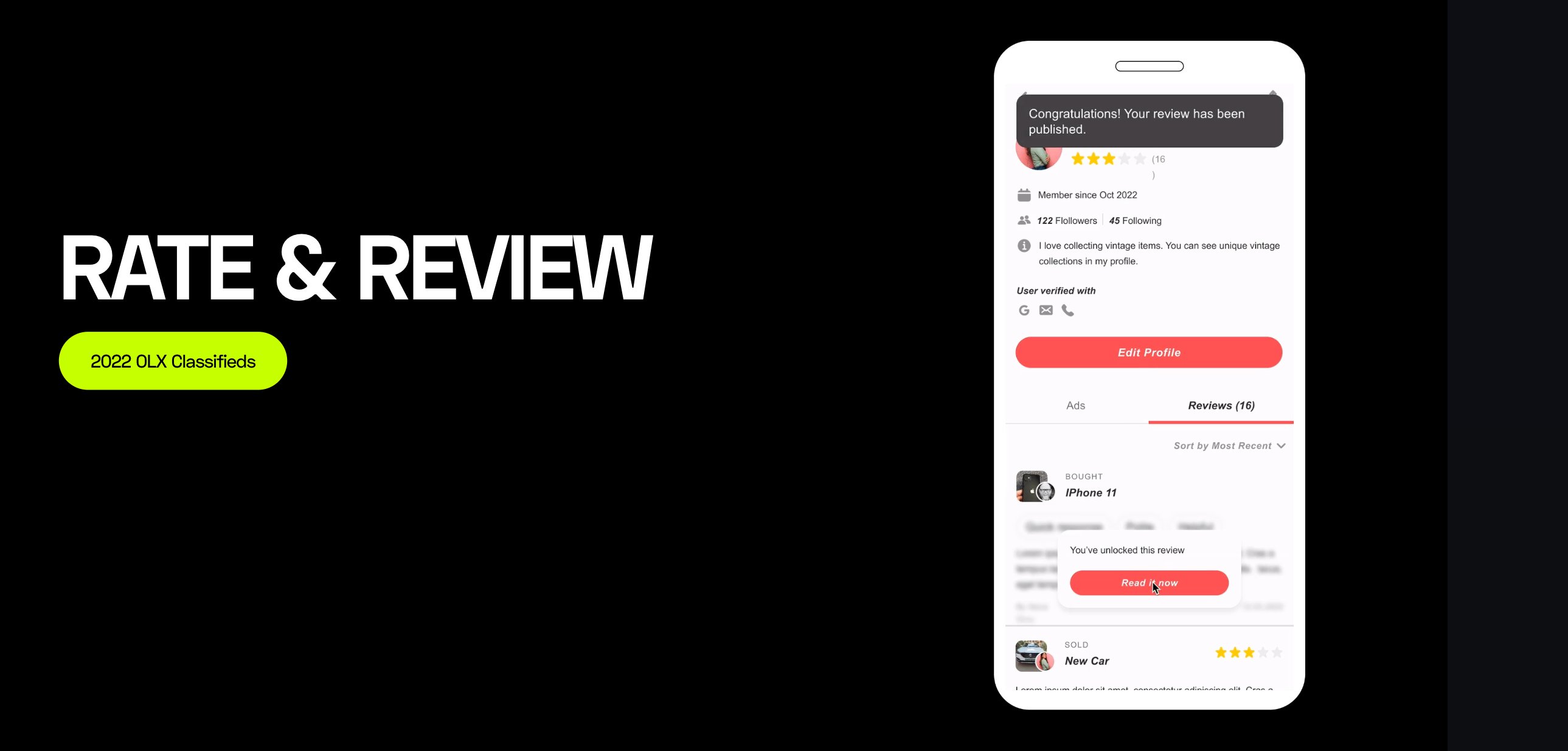
Each user profile gained a trust score surfaced as a star rating with a review count, alongside verification badges (phone, email, Google) and a transaction history timeline. Reviews were bilateral — both buyer and seller could rate each other — with a blind review mechanic preventing retaliatory ratings.
To handle cultural nuance, review prompts were localised per market — more direct in Turkey, more relationship-focused in Indonesia. The rating scale used a 3-tier positive/neutral/negative model rather than 5 stars, which tested better across all three markets for clarity.
Impact across
three markets
The Rate & Review feature launched across Turkey, India, and Indonesia within the 6-month target. Early adoption showed strong organic engagement — users were motivated to build reputation without explicit incentivisation.
Android
Web
Beyond metrics, the project established OLX's first cross-market trust design framework — a set of principles and reusable components that could be extended to future safety features across the platform's 40+ markets.
What I learned
Designing for trust across cultures taught me that there is no universal UX pattern for safety. What feels reassuring in one market can feel invasive or unnecessary in another. The research phase wasn't just due diligence — it was the foundation the entire system was built on.
Working with engineering across three timezones also pushed me to invest heavily in documentation and annotation — the design spec wasn't just a handoff artefact, it was a communication tool that needed to work without me in the room.
"The best trust features are invisible when they work — users just feel safe, without knowing why."